
In the era of Industry 4.0, the concept of Japan’s digital cliff (also known as the “2025 Digital Cliff”) is no longer a distant forecast from Japan’s Ministry of Economy, Trade and Industry (METI). Entering 2026, Japan’s digital cliff has become a harsh reality that the world’s third-largest economy must confront head-on. For technology companies like DTS Software Vietnam, understanding this digital cliff is key to unlocking strategic cooperation opportunities.
Japan’s Digital Transformation landscape and the 2025 Digital Cliff
Japan has long recognized that falling behind digitally could weaken productivity and economic growth. As early as the DX Report 2018, METI warned that Japan could face a “2025 Digital Cliff” if many companies continued to resist adopting modern digital systems. In reality, several indicators show that Japan’s digital transformation has progressed more slowly than other developed economies:
Low adoption of digital payments: In 2022, only 36% of transactions in Japan were cashless—far lower than in South Korea, Singapore, and other markets. A strong cash culture and traditional business habits have slowed the adoption of electronic payments.
Outdated administrative processes: Many public services in Japan remain insufficiently digitized. Around 1,900 administrative procedures still rely on legacy storage technologies (CDs, floppy disks), forcing citizens to submit documents in person. For example, during COVID-19, a government official used a floppy disk to submit relief data, which reportedly led to an error that resulted in 46.3 million yen being mistakenly transferred to an individual.
Weak digital competitiveness: According to the IMD World Digital Competitiveness Ranking, Japan placed 29th out of 63 economies, behind Singapore, South Korea, and Mainland China.
These numbers suggest that many Japanese companies remain “stuck in the past”—continuing to operate on outdated systems and manual processes even as the rest of the world has advanced into the digital era. This is the core backdrop of Japan’s Digital Cliff: without decisive change, the digital gap between Japan and other nations will continue to widen, threatening the country’s economic position beyond 2025.
The latest context in 2026: from warning to reality
Now that we are in 2026, Japan’s Digital Cliff is no longer theoretical. It shows up in operational stagnation, soaring maintenance costs, and reduced business agility. Faced with this reality, Japanese companies are actively seeking external solutions to help them “jump” over the cliff safely and sustainably.
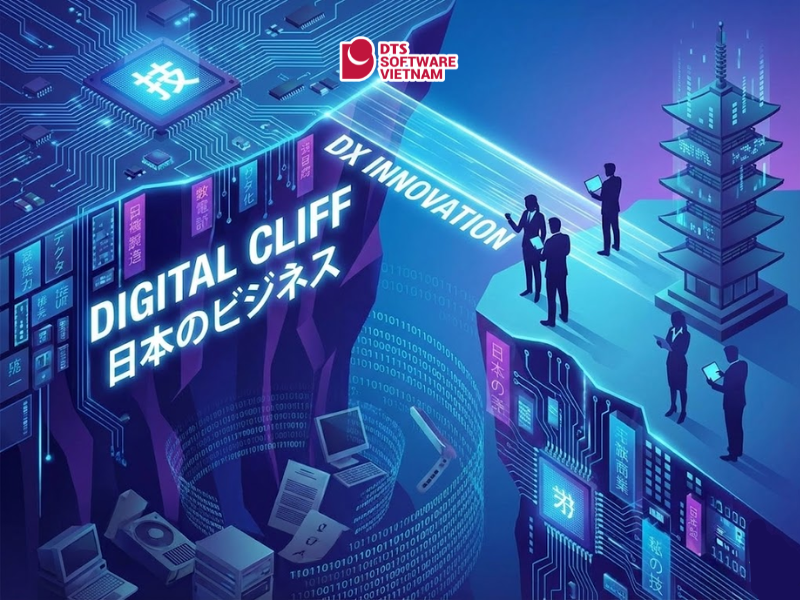
The root causes behind Japan’s Digital Cliff
To solve the problem, we must understand what creates it. Three major factors form the foundation of this difficult barrier:
The heavy burden of legacy systems
One of the main reasons Japan’s Digital Cliff is so dangerous is the persistent dependence on legacy systems. By 2025, an estimated 60% of IT systems in Japan were over 20 years old, and around 80% of companies still relied on them. Rebuilding from scratch is extremely challenging due to technical barriers.
These systems often:
Were built decades ago using outdated programming languages.
Became “black boxes” when the original developers retired—leaving few people who truly understand how to upgrade them.
Consume a large share of IT budgets for maintenance, draining resources that could otherwise fuel innovation and pushing companies closer to the edge of the Digital Cliff.
The complexity and aging nature of Japan’s technology infrastructure is a “boulder” at the heart of the Digital Cliff, slowing business growth in an increasingly competitive global landscape.
Severe IT talent shortages
The human factor is the second driver worsening Japan’s Digital Cliff. Japan is projected to face a shortage of up to 450,000 IT professionals by 2030, driven by an aging population and low birth rates. This creates a critical lack of engineers capable of handling modern technologies such as AI, cloud computing, and big data.
Key consequences include:
Too few young professionals to take over and modernize systems.
Fierce competition for talent, which pushes recruitment costs higher.
A widening digital skills gap that makes it harder for companies to respond effectively.
This shortage has turned Japan’s Digital Cliff into a pressing concern for business leaders across the country.
High costs and risks of transformation
Large-scale IT modernization requires significant investment and long timelines. Many Japanese business leaders are cautious about risk: if legacy systems still “work,” they worry that change could be expensive without delivering proportional benefits. This “don’t fix what isn’t broken” mindset often delays digital transformation decisions.
Beyond that, Japanese businesses tend to prioritize stability and precision, which can lead to a preference for familiar methods over experimentation. A fear of mistakes and of disrupting established norms slows adaptation to new technologies. As one noodle shop owner, Ueki in Tokyo, shared, he “feels comfortable with what he has” and “never thought about changing” his traditional way of operating (Source: “Japan’s digitalization battle” – Can Tho Online).
Together, these factors create an “invisible wall” blocking transformation. But unlike a wall you can climb gradually, the Digital Cliff represents a sudden drop—if companies don’t act quickly, they risk a collapse. A single serious incident in a legacy system (such as data loss or a cyberattack) can paralyze an entire organization—sending it “over the edge” with little chance of recovery.
Japan’s government response: DX and GX initiatives
Facing the risk of the Digital Cliff, the Japanese government has launched national-level initiatives to accelerate Digital Transformation (DX) across both the public and private sectors.
In 2021, Japan established the Digital Agency to unify and speed up government digitization efforts. Prime Minister Fumio Kishida pledged to accelerate digital transformation and committed 5.7 trillion yen (approx. USD 42 billion) to improve digital infrastructure—especially in local regions facing labor shortages due to population aging. He also appointed Taro Kono as Digital Minister, widely known for his campaign to “declare war” on outdated floppy disks and fax machines (Source: VnExpress).
METI has also continued to update its DX strategy. In 2024, the ministry established a System Modernization Committee to explore solutions for eliminating legacy systems in businesses. Recommendations include: reshaping leadership mindset on the strategic importance of IT, strengthening technology governance, elevating the role of IT departments, and continuously developing digital talent. The government also introduced DX assessment tools to help companies measure their digital maturity and create improvement roadmaps. These policies aim to help Japanese businesses “save themselves” before it’s too late.
Alongside DX, Japan is also driving Green Transformation (GX)—a shift toward a greener energy and economic model. GX supports Japan’s goal of achieving carbon neutrality by 2050, while promoting sustainable economic growth.
Japan approved the GX Basic Plan (2023) with a 10-year roadmap, aiming to mobilize over 150 trillion yen in public-private investment to shift from fossil fuels to clean energy. GX policies emphasize advanced technology adoption and market-based mechanisms (such as GX bonds and carbon pricing) to reduce emissions while sustaining growth.
While DX and GX are distinct—one focused on digitization, the other on decarbonization—both serve as strategic pillars to restructure Japan’s economy, boost productivity, and help the country avoid future “cliffs” in technology and environmental challenges.
Practical solutions for Japanese enterprises and Vietnamese Marketplace’s strengths
Even with strong government support, Japanese companies must take proactive steps to overcome the Digital Cliff. Below are practical directions worth considering:
Comprehensive Digital Transformation (DX)
Digital transformation is no longer optional—it is the only viable path away from Japan’s Digital Cliff. Companies should:
- Conduct a full inventory of current systems and identify outdated or high-risk applications and databases.
- Move infrastructure to the cloud (cloud migration).
- Apply AI and automation to reduce dependency on manual work.
- Redesign business processes to fit a digital-first era.
A decisive DX effort can “flatten” the Digital Cliff—turning challenge into a new engine for growth.
Process optimization and standardization
Alongside technology upgrades, businesses should simplify operations and standardize data across systems. This reduces complexity and prevents duplication when deploying new platforms. Source code analysis and IT asset management tools can help identify redundant modules, consolidate databases, and streamline the system before transformation.
Leverage support from technology partners
If internal resources are limited, companies should collaborate with reputable technology partners. Consulting firms and experienced IT service providers—especially those familiar with Japanese projects—can accelerate transformation by advising on optimal DX roadmaps, handling complex implementation, and enabling effective technology transfer.
Outsourcing parts of IT work is also an effective way to address talent shortages and reduce operational costs. Many reports suggest that partnering with overseas providers can reduce costs by up to 50% compared to maintaining internal teams, while also expanding access to diverse expertise.
DTS Software Vietnam: A trusted partner to help businesses overcome Japan’s Digital Cliff
In the journey to overcome Japan’s Digital Cliff, DTS Software Vietnam can be a reliable technology partner for Japanese enterprises. With more than 11 years of experience and operations across both Japan and Vietnam, we are proud of our talented young engineering teams—professionals who understand not only technical requirements but also Japanese business culture. We are ready to support Japanese clients through complex digital transformation initiatives.
DTS Software Vietnam brings key strengths that help businesses cross the Digital Cliff:
- Deep understanding of the Japanese market: As a 100% Japanese-invested company, DTSVN has contributed to numerous software and BPO projects for Japanese enterprises.
- Cost-effective delivery model: With a combined offshore and on-site approach, DTSVN provides high-quality IT talent from Vietnam at competitive cost.
- End-to-end services: DTSVN delivers comprehensive DX support—from roadmap consulting and new software development to system integration and long-term operation & maintenance.
Vietnam–Japan collaboration can be one of the strongest bridges to cross Japan’s Digital Cliff.
Japan’s Digital Cliff is a complex socio-economic phenomenon that requires joint action from both government and businesses. 2026 is a pivotal moment for Japanese companies: they can either make a leap beyond the Digital Cliff—or risk falling behind.