GX (Green Transformation – green transition) and DX (Digital Transformation – digital transformation) are both leading strategic transformation trends in modern businesses. However, these two concepts differ fundamentally in their objectives and scope of impact. Especially in Japan—a pioneering technology economy—both GX and DX are being emphasized to enhance competitiveness and sustainable development.
Basic Concepts of GX and DX
Before diving deeper into the comparison between GX and DX, we need to clearly understand the nature of each term.
What is Digital Transformation (DX)?
DX is the application of digital technologies (AI, IoT, Big Data, Cloud, etc.) across every aspect of a business. The goal of DX is not merely to “digitize” documents, but to comprehensively change the way operations run, business models function, and organizational culture evolves. DX helps businesses optimize processes, improve customer experience, and create breakthrough new value.
The concept of DX was first mentioned in 2004, but in Japan, DX only truly began to surge around 2018 when the Ministry of Economy, Trade and Industry (METI) started implementing policies to promote digital transformation. METI warned about the “2025 digital cliff”—the risk that old, outdated IT systems would hinder growth. METI’s DX Report 2018 estimated that if digital transformation is not implemented in time, Japan could suffer economic losses of up to 12 trillion yen per year after 2025 due to legacy systems. This served as a wake-up call for businesses about the urgency of DX.
What is Green Transformation (GX)?
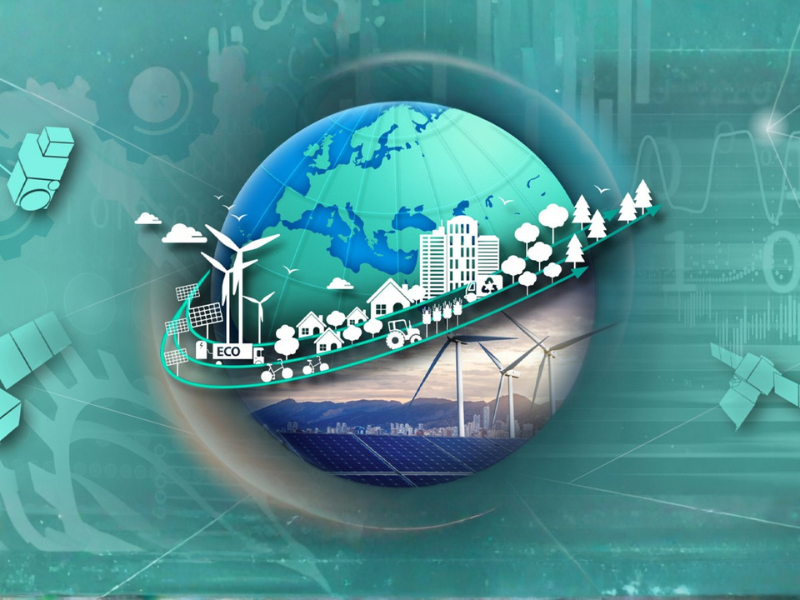
GX (Green Transformation) is the process of transforming the economy and society toward reducing greenhouse gas emissions, protecting the environment, and achieving sustainable development. For businesses, GX includes energy transition (from fossil fuels to renewable energy), adopting a circular economy, and complying with ESG standards (Environmental, Social, and Governance).
The core goal of GX is to reduce greenhouse gas emissions and respond to climate change while still maintaining economic growth. According to the definition of GR Japan, green transformation refers to a comprehensive restructuring of the economic and industrial system—from dependence on fossil energy to a structure driven by clean energy—aimed at achieving growth through emissions reduction.
In Japan, GX is seen as the “key” to both achieving ambitious climate targets and enhancing national competitiveness. The Japanese government has committed to cutting greenhouse gas emissions by 46% by 2030 (compared to 2013 levels) and reaching carbon neutrality by 2050. To achieve these goals, Japan has developed a large-scale GX strategy with an estimated public–private investment of up to 150 trillion yen (equivalent to ~1 trillion USD) over a decade. The GX strategy includes a roadmap to reform energy and industrial policies, deploy low-carbon technologies, and develop a carbon credit trading market.
In 2022, the government established the GX League—an alliance that brings together pioneering companies committed to reducing emissions. As of 2023, the GX League had attracted more than 550 Japanese companies, accounting for 40% of national emissions, along with commitments to an emissions reduction roadmap through 2030 and carbon neutrality in 2050.
Differences Between GX and DX
When placing GX and DX side by side, we can see that both are strategic “transformations” that require changes from leadership mindset to execution processes.
Core objective
The biggest difference between GX and DX lies in the destination. The goal of DX focuses on economic efficiency, processing speed, labor productivity, and competitive advantage in the digital market. In contrast, GX focuses on environmental responsibility, reducing carbon footprint, and ensuring the long-term survival of a business in a world of scarce resources.
In other words, when comparing GX and DX, DX tends toward “growth” while GX tends toward “sustainability.”
Scope of impact
DX primarily impacts operating systems and work processes—for example, digitizing workflows, applying management software, and using big data analytics to make decisions.
GX affects the value chain and production/business model—from improving energy usage (switching to renewable energy, improving power consumption efficiency), adjusting production processes (reducing waste, circular resource use), to designing products in an environmentally friendly way.
In other words:
DX transforms the “digital” side of operations.
GX transforms the “green” side of strategy and business model.
Driving forces
The driving forces behind GX and DX are also different.
DX is often driven by market competition, changing customer needs, and rapid technological growth.
GX is driven by regulatory pressure (environmental protection laws), international commitments (Net Zero), and strict investor demands on ESG.
However, today, the pressure to implement both GX and DX is converging as consumers increasingly prioritize brands that are both “green” and “smart.”
Benefits delivered
DX helps businesses:
Increase productivity and revenue
Reduce operating costs through automation
Create smarter products and services (e.g., mobile apps, e-commerce platforms)
Enhance customer experience
GX brings benefits such as:
Long-term energy and cost savings (through efficient resource use)
Stronger “green brand” image among consumers
Compliance with strict environmental regulations
Reduced risk of penalties or lost market opportunities due to failure to meet emissions standards
Implementation challenges
DX requires changes to IT infrastructure, corporate culture, and workforce skills. Many Japanese companies struggle with DX due to complex legacy systems, a lack of technology talent, and reluctance to change. Statistics show that only about 10% of listed companies in Japan participate in government DX programs (such as obtaining DX certification or being in the GX League), reflecting that most businesses are still struggling with their digital transformation journey.
In contrast, GX is no less challenging because it requires:
Large investment in new technologies (renewable energy, green production lines)
Longer payback periods
Coordinated collaboration across the entire supply chain
Many companies need government support (financially and through policy) to boldly invest in emissions-reduction solutions.
The Relationship Between GX and DX: The “Dual Transformation” Trend
DX aims at digital transformation, while GX aims at environmentally sustainable transformation. DX mainly answers “how can a business operate more efficiently through technology,” while GX answers “how can a business grow while minimizing negative impact on the planet.”
Despite these differences, the two trends do not exclude each other; they are closely linked and mutually reinforcing.
In Japan, a new mindset is emerging:
“DX to implement GX”
“GX to promote DX”
Businesses need to apply digital technology (DX) to manage and reduce emissions effectively (to succeed in GX); at the same time, shifting to green energy and green infrastructure (GX) will create a sustainable foundation for stronger digitalization (DX).
The Japanese government has emphasized this linkage in many documents. For example, Japan’s GX roadmap mentions applying digital platforms to measure and disclose CO₂ emissions data across the digital economy, treating this as an activity that must be promoted.
Conversely, Japan’s ICT White Paper 2022 warned that if DX continues to expand without being accompanied by GX, electricity demand for data centers and telecommunications networks could increase by 550 times compared to 2018—an enormous level of energy consumption that would be difficult to accept in the context of emissions reduction.
Therefore, DX and GX must be advanced simultaneously to ensure that digital transformation does not worsen environmental problems, and that green transformation is supported by advanced digital technology.
In reality, Japanese companies still have not fully exploited the potential of combining these two: only about 3.5% of listed companies are actively implementing both DX and GX at the same time. This shows there is still significant opportunity for businesses to integrate the two trends toward a “sustainable digital enterprise” model in the future.
Companies that pioneer a balanced combination of GX and DX will certainly gain long-term competitive advantages—operating efficiently through digitalization while developing sustainably through green transformation.
GX and DX Trends in Japan’s Information Technology Industry
In Japan, digital transformation (DX) is becoming a matter of survival for many businesses, especially in the information technology sector. However, the DX landscape in this country has distinctive characteristics: it faces strong pressure while also encountering major barriers that must be overcome.
Pressure and barriers
In terms of pressure, as mentioned, the “2025 digital cliff” is a powerful warning bell. As early as 2018, METI announced this risk and urged businesses to quickly modernize their IT systems to avoid falling behind.
In terms of barriers, traditional business culture and outdated technology systems are major obstacles to DX in Japan. Many Japanese companies still operate on legacy systems (mainframes, COBOL) and paper-heavy processes.
GX alongside DX in Japan’s IT sector
Alongside DX, green transformation (GX) is also becoming a strategic trend in Japan’s IT industry. Both the government and Japanese enterprises recognize that digital transformation must go hand in hand with green transformation to achieve a sustainable digital economy.
This approach is emphasized in the Digital Governance Code 2.0 (Digital Governance Code 2022), where the government called on companies to promote both DX and GX within their growth strategies.
Notable GX trends in technology
In the technology field, notable GX trends include:
Green data centers
Green coding
Energy-saving AIoT
New-generation data centers in Japan are shifting to 100% renewable energy, applying efficient cooling systems, and leveraging AI to optimize electricity usage.
In software, the “green coding” movement encourages developers to write optimized code that consumes as few processing resources as possible, thereby reducing device energy consumption and indirectly reducing emissions from the technology industry.
AIoT (AI of Things) solutions are also deployed in smart buildings and smart factories to automatically adjust lighting, temperature, and shut down equipment when not in use—helping achieve significant energy savings.
Thanks to DX, businesses can measure and track carbon footprint in more detail—for example, using ESG management software integrated into ERP systems to calculate emissions and generate reports aligned with international standards.
Example: GX and DX integration at SCSK
In particular, a key trend is the integration of GX and DX in business strategies among Japanese IT companies. A typical example is SCSK (part of the Sumitomo Group). SCSK established a GX Business Division in 2023 and introduced the slogan “GX x DX”—leveraging digital technology to help customers manage carbon emissions more effectively.
The company focuses on solutions for small and medium-sized enterprises, providing cloud platforms that enable companies to calculate and reduce emissions across their supply chains.
GX Business Division’s solutions portfolio (Source: SCSK)
According to SCSK’s report, by applying digital platforms, they can automate emissions measurement based on SMEs’ accounting data, significantly reducing the workload of manual calculations.
SCSK also built an online renewable energy certificate trading platform (EneTrack) and a smart energy management service for buildings (ZEBiT) to promote GX across multiple sectors.
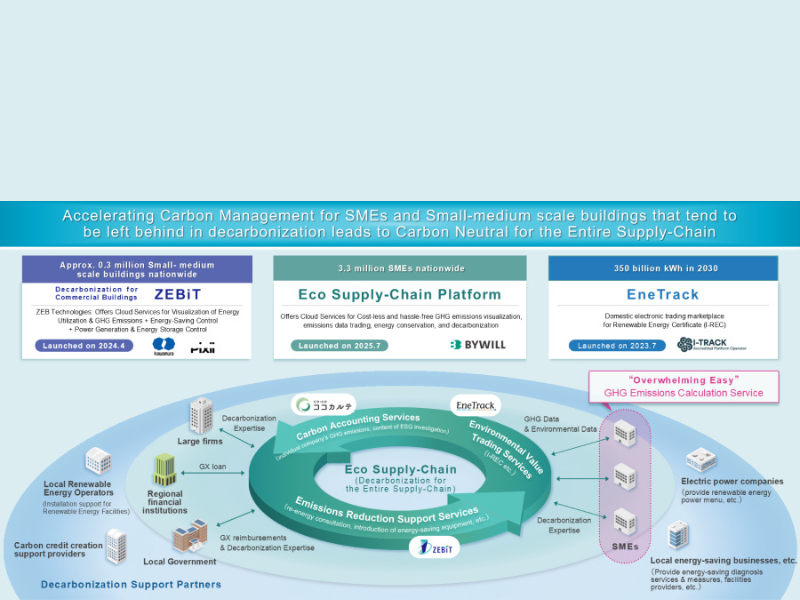
SCSK’s case shows that Japanese IT companies are not only greening their own operations, but are also actively innovating digital products and services to “get ahead” of customer demand for green transformation.
Overall outlook
Overall, GX trends in Japan’s technology sector are rising strongly, supported by both the government and the private sector. Japan is ready to invest massive resources (150 trillion yen over 10 years) into GX initiatives, creating a favorable environment for technology businesses to develop “green” products and services.
As a result, Japan’s green tech market is thriving—from large-scale smart city and smart grid solutions to specialized green software applications.
This is both a challenge and an opportunity for IT enterprises to affirm their role as the “conductor” in the dual green–digital transformation.
DTS Software Vietnam: Supporting Businesses in Both Digital and Green Transformation (GX and DX)
Amid the strong waves of GX and DX, DTS Software Vietnam—an affiliate of Japan’s DTS Corporation—proudly serves as a trusted partner supporting businesses in successfully achieving both transformation goals.
With strengths in understanding both the Japanese and Vietnamese markets, DTS Software Vietnam provides advanced technology solutions to address the tough challenges of GX and DX:
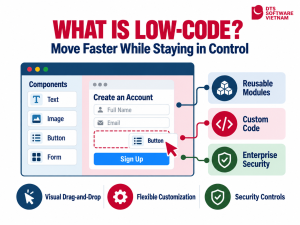
No-code/Low-code solutions
This is the key to accelerating GX and DX. DTSVN’s no-code/low-code platform helps businesses build digital transformation applications quickly at lower cost, reducing the burden on engineering resources.
At the same time, these applications help digitize paper-based workflows, reduce office waste, and directly contribute to GX goals.
Rapid deployment of internal management systems through low-code is a typical example of the effective integration between GX and DX.
ESG & SDGs consulting
Inheriting the sustainability philosophy from our parent group, DTS Software Vietnam not only provides IT tools but also consults on how to integrate ESG standards into governance systems.
We support businesses in building transparent data infrastructure, creating a solid foundation for both GX and DX roadmaps.
Operational process optimization
Through high-quality BPO and ITO services, DTSVN helps customers streamline organizational structures, reduce waste of resources and energy, and realize GX and DX commitments in even the smallest operational steps.
The combination of Japanese technology capabilities and high-quality human resources in Vietnam enables DTSVN to deliver optimal GX and DX solutions—helping businesses not only become “faster” through DX but also “greener” through GX.