In recent years, the rapid rise of AI has fundamentally reshaped the global IT landscape. Major tech companies have been laying off employees and slowing hiring to optimize costs while leveraging AI to boost productivity. Tools such as AI coding assistants, automated testing systems, and generative AI are increasingly replacing repetitive programming tasks.
This raises an important question: Is Vietnam’s IT workforce—especially in outsourcing—facing an opportunity or a threat?
Global Context: AI-Driven Layoffs Are Accelerating
Between 2025 and 2026, the global tech industry saw over 123,000 IT layoffs in 2025 alone. Companies like Oracle (30,000 employees), Dell (11,000), and Block (4,000) cited AI adoption as a key driver.
Entry-level and mid-level coding roles focused on repetitive tasks are being replaced rapidly by generative AI, leading to a sharp decline in hiring across the US and Europe.
Some experts refer to this as “AI washing”—using AI as a justification for cost-cutting after aggressive post-COVID hiring. However, the reality is more nuanced: AI is not eliminating human roles entirely but shifting demand toward higher-value positions such as:
AI integration
MLOps
Ethical AI
Domain-specific solutions
Vietnam: Moving Against the Tide
While many markets struggle, Vietnam is emerging as a strong outsourcing destination. With:
530,000–560,000 developers
55,000–60,000 new IT graduates annually
Over 23,000 AI specialists
Vietnam offers not only scale but also cost advantages—15–30% lower than India—combined with a young workforce (over 58% under 30) and fast delivery capabilities. The IT outsourcing market in Vietnam is projected to reach $0.98 billion by 2026, with an annual growth rate of 12–17%.
Why Vietnam’s IT Workforce Remains a Bright Spot
Cost–Quality Advantage
Vietnam provides a rare balance between affordability and technical quality. Compared to Eastern Europe or Japan, costs are significantly lower while still meeting enterprise-level requirements.
Young, Adaptive Talent Pool
Vietnam’s IT workforce stands out for:
A young demographic
Strong self-learning capabilities
Rapid adoption of new technologies
Each year, universities produce tens of thousands of IT graduates, with a target of reaching 80,000–100,000 annually by 2030.
Vietnamese developers are also among the most active users of AI tools like GitHub Copilot, Cursor, and automation agents in the region.
Strong AI Capabilities
Vietnam now has over 23,000 AI professionals, and the AI market is expected to reach $680 million by 2026.
AI adoption rate: 83% (vs. global average of 69%)
38% of workers use generative AI daily
Major players like FPT are investing heavily (e.g., $200M AI Factory with NVIDIA), while outsourcing firms are shifting toward AI-augmented development services.
Emerging as Southeast Asia’s AI Hub
With investments from organizations like FPT, VinAI, and global data center operators (NVIDIA, Samsung), Vietnam is evolving from a “coding workforce” to AI engineers capable of:
Fine-tuning models
Building AI agents
Deploying enterprise AI solutions
Strategic Advantage in the Japanese Market
Japan is facing the so-called “Digital Cliff 2025”, with a projected shortage of 800,000 IT professionals by 2030 due to an aging population.
In this context, Vietnam has become Japan’s #2 outsourcing partner, after India.
Vietnamese engineers are actively supporting Japan’s critical systems across:
Banking & finance
Manufacturing
Smart infrastructure
AI systems
Why Japan Chooses Vietnam
High cultural compatibility (kaizen mindset, discipline, attention to detail)
Time zone alignment (only 2-hour difference)
Cost efficiency (25–35% of domestic Japanese developer costs)
Evolving collaboration model (from manpower to AI co-creation)
Vietnamese firms are no longer just service providers—they are becoming co-innovation partners.
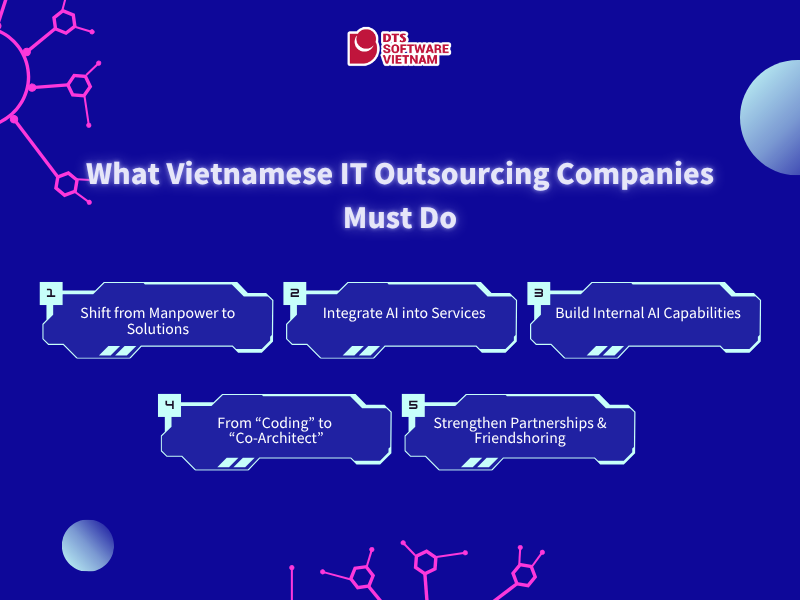
The Reality: AI Is Not Killing Outsourcing—It’s Reshaping It
The traditional Time & Material model is becoming obsolete.
Companies must:
Sell outcomes
Deliver solutions
Example: Instead of providing 5 developers, offer solutions that reduce workload by 30%.
Integrate AI into Services
Apply AI directly into operations:
AI coding
Test automation
AI CAD/design
Document processing
Build Internal AI Capabilities
A focused R&D team can:
Develop internal tools
Automate workflows
Create proprietary products
This becomes a long-term competitive advantage.
From “Coding” to “Co-Architect”
Clients in 2026 don’t hire you to write code anymore.
They hire you to:
Design scalable architectures
Ensure quality and security of AI-generated code
Advise on AI adoption strategies
Strengthen Partnerships & Friendshoring
Companies like DTS Software Vietnam should:
Expand strategic partnerships with Japan
Align with Vietnam’s AI regulations (effective March 2026)
Soft skills also matter:
Japanese language
Cultural understanding
Domain knowledge
AI is not destroying IT outsourcing – it is eliminating those who fail to adapt.
“AI won’t replace programmers, but programmers who use AI will replace those who don’t.”
Vietnam now has a unique opportunity to move beyond the label of “low-cost outsourcing” and become a high-value technology solution hub.
With strong AI capabilities, competitive costs, and deep cultural alignment with Japan, Vietnam’s IT workforce is not just surviving the AI wave—it is becoming a key growth engine for global partners.