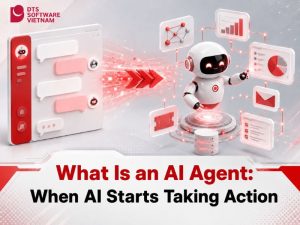
What is an AI Agent? An AI Agent, or autonomous AI, is an artificial intelligence system capable of receiving goals, analyzing context, planning, using tools and performing actions with a certain level of autonomy. An AI Agent can handle multi-step tasks such as connecting data, generating reports, sending alerts, recommending solutions or supporting partial automation of workflows. In short, the question “What is an AI Agent?” can be understood as how AI moves from providing information to supporting the execution of specific tasks.
What Is an AI Agent?
What is an AI Agent? An AI Agent, or autonomous AI, is an artificial intelligence system capable of receiving goals, using tools and performing actions within a predefined scope. According to Google Cloud, an AI Agent can pursue goals, complete tasks and possess capabilities such as reasoning, planning, memory and adaptation. Unlike chatbots, which mainly help users find answers, AI Agents can support multi-step work execution. For example, with a request such as “summarize IT tickets for the week,” an AI Agent can retrieve data, classify issues, generate reports and suggest solutions.
Therefore, when learning what an AI Agent is, businesses should not view it merely as a technology for responding to information, but as a development that enables AI to participate more directly in operational workflows.
How Does an AI Agent Work?
An AI Agent typically operates through a four-step cycle: receiving a goal, planning, using tools and performing controlled actions. Understanding what an AI Agent is will help businesses identify how this technology participates in each step of a workflow.
What Is an AI Agent in the Goal-Receiving Step?
An AI Agent begins by receiving a request from a user or system, such as generating a report, classifying customer requests or checking common error groups. At this step, the agent needs to understand the goal, processing scope, data to be used and expected output.
Planning and Breaking Down Tasks
After understanding the goal, the AI Agent analyzes the context and breaks a large task into smaller steps. For example, with a request to generate an operational performance report, the agent can determine where to retrieve data, which criteria to filter by, how to present the results and which steps require human review.
Using Tools and Data
An AI Agent can connect with tools such as APIs, CRM, ERP, email, ticket management software or internal data repositories to retrieve information and generate results. This is what enables an AI Agent not only to answer questions, but also to participate in real-world workflows.
Performing Controlled Actions
After collecting sufficient data and creating a processing plan, an AI Agent can perform actions within the scope of its granted permissions, such as generating reports, sending alerts, updating statuses or recommending solutions. For important tasks, businesses need to maintain a human-in-the-loop mechanism so that people can review and approve the final step before the agent executes it.
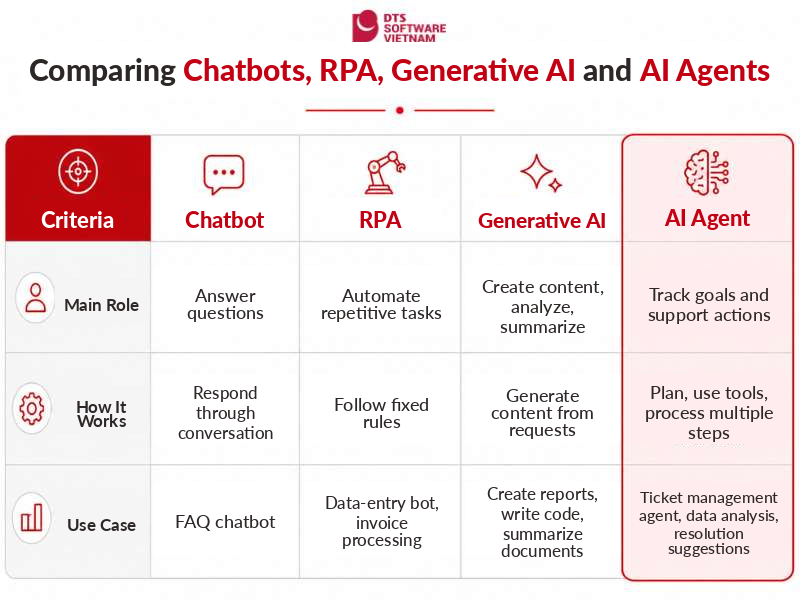
How Is an AI Agent Different from a Chatbot, RPA and Generative AI?
AI Agents are often mentioned alongside chatbots, RPA and generative AI, but these are different concepts. Understanding what an AI Agent is will help businesses clearly distinguish the role of each technology in automation and digital transformation.
Chatbots help businesses communicate faster, RPA helps perform operations faster, generative AI helps create and process knowledge faster, while AI Agents help turn those capabilities into action within specific workflows. This comparison helps businesses better understand what an AI Agent is and why this technology differs from traditional automation tools.
Why Do Businesses Need to Understand What an AI Agent Is?
For many years, businesses have applied AI to support data analysis, task automation and content creation. However, the major challenge is not whether a business uses AI, but whether AI creates real value in operations.
According to McKinsey’s The State of AI: Global Survey 2025, 88% of survey respondents said their organizations are using AI regularly in at least one business function, up from 78% the previous year. For agentic AI specifically, 23% of respondents said their organizations are scaling agentic AI systems somewhere within the business, while another 39% have started experimenting.
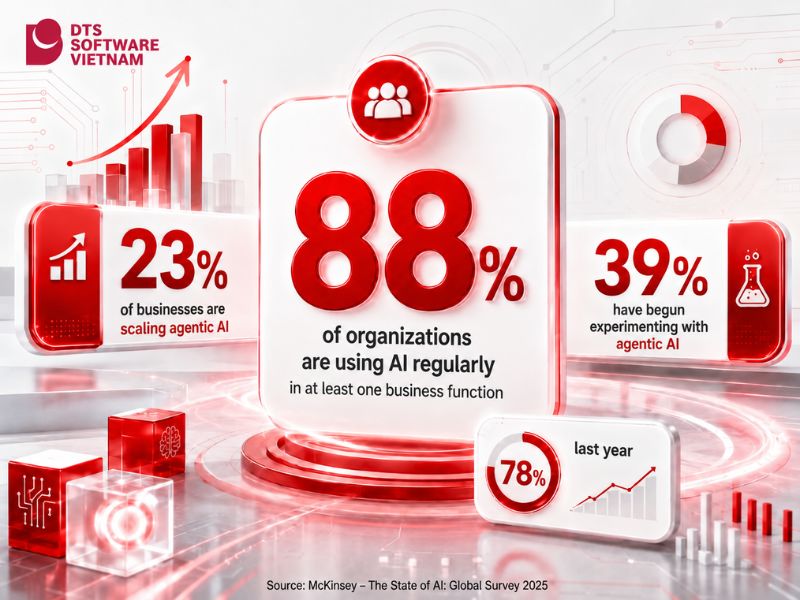
What Is an AI Agent? McKinsey’s 2025 data shows that AI Agents are becoming a notable trend among businesses. This indicates that AI Agents are moving beyond the experimental stage and toward practical applications that deliver real business value. For enterprises, AI Agents can bring three key groups of benefits:
- Increased processing speed: reducing time spent on repetitive tasks such as report summarization, request classification and data checking.
- Improved decision quality: supporting data analysis, trend identification and abnormality alerts.
- Optimized resources: helping employees focus on work that requires thinking, creativity and customer interaction.
MIT Sloan also describes agentic AI as a development direction that differs from traditional generative AI tools, as agents can support the automation of complex, multi-step workflows. At the same time, implementation needs to be associated with infrastructure, security and human supervision.
Applications of AI Agents in Businesses
When learning what an AI Agent is, businesses need not only to understand the concept, but also to identify which operational problems this technology can solve.
AI Agents in Customer Service
An AI Agent can receive requests, classify issues, look up customer history, suggest responses and route requests to the right department. For repetitive questions, agents help reduce the workload for customer service teams and shorten response times.
AI Agents in IT Helpdesk
In IT Helpdesk, an AI Agent can classify tickets, suggest solutions, look up instruction documents and identify recurring errors. For example, when many employees encounter the same system access issue, the agent can group the problem and alert the IT team to investigate the cause.
AI Agents in Software Development and Testing
An AI Agent can support requirement analysis, summarize technical documents, suggest source code structures, create unit tests, recommend test cases, classify bugs and summarize logs for quality management.
AI Agents in Data Processing and Reporting
For data-related operations, an AI Agent can check input data, detect missing information, classify data, generate reports and alert abnormalities. This group of applications is suitable for businesses that need to process large volumes of data while still ensuring accuracy and consistency.
DTSVN and the Direction of Applying AI Agents from a Generative AI Foundation
For DTS Software Vietnam, answering the question “What is an AI Agent?” is directly linked to the direction of developing generative AI into solutions capable of supporting actions in operations. From the foundation of generative AI, AI Agents open up a new stage of development in which AI not only creates content or analyzes information, but can also plan, connect data and support actions within workflows.
Generative AI Is the Foundation, AI Agents Are the Next Step Toward Action
Generative AI helps businesses create documents, analyze information, support coding, generate test cases and standardize reports. When developed into AI Agents, these capabilities are connected into a workflow with a clear goal, from receiving requests and processing data to recommending next steps.
Aligned with DTSVN’s Technology Service Direction
With solution groups such as Cloud and system modernization, Data Analytics, security, IoT, CX, BPO and AI & Generative AI, DTSVN has a suitable foundation to develop AI Agents into an extended application layer that supports ticket management, data processing, report summarization, document analysis and system operations.
What Is an AI Agent When It Creates Higher Added Value for Customers?
AI Agents help transform AI from a response tool into a tool that participates in workflows. For enterprise customers, this technology can help reduce manual operations, increase processing speed, standardize outputs and make better use of data.
AI Agents Need to Be Implemented with Control
DTSVN does not approach AI Agents as a way to completely replace humans. For tasks related to data, customers or important decisions, AI Agents need to be implemented with permission control, security and human supervision.
Understanding What an AI Agent Is to Implement It Effectively and Safely
Understanding what an AI Agent is helps businesses choose the right starting point instead of implementing AI simply as a trend. Businesses should not begin AI Agent implementation with a system that is too large or too complex. A more suitable approach is to select a small workflow with clear data, measurable outcomes and controllable risks. At the same time, AI Agents need to be implemented together with appropriate governance mechanisms to avoid issues related to data, security, information bias or excessive dependence on AI.
A basic implementation roadmap includes:
- Reviewing current workflows: identifying repetitive, time-consuming or error-prone tasks such as ticket classification, report summarization, data checking or document lookup.
- Selecting priority use cases: starting with a small use case that has clear value and does not create major operational risks.
- Standardizing data: ensuring that data is clean enough, structured, access-controlled and managed according to security requirements.
- Designing the scope of action: defining what the AI Agent is allowed to do automatically and which steps require human review and approval.
- Running a small pilot: implementing a pilot in one department or one specific workflow before expanding.
- Measuring effectiveness and risks: tracking processing time, error rates and user satisfaction, while also checking risks such as inaccurate results, lack of transparency or inappropriate data access.
- Scaling with control: after proving effectiveness, businesses can integrate AI Agents into other workflows, but need to maintain processing logs, permission control, security and a human-in-the-loop mechanism.
This step-by-step approach helps businesses avoid adopting AI merely as a trend, while ensuring that AI Agents are applied safely, transparently and in a way that creates real operational value.
Understanding What an AI Agent Is: Will This Technology Replace Humans?
AI Agents can replace part of certain tasks, but they should not be viewed as tools that completely replace humans. Repetitive tasks with clear data and relatively stable processes are suitable areas where AI can provide strong support. On the other hand, tasks that require strategic judgment, emotion, ethics, legal responsibility and human understanding still require people to play the decisive role.
A more appropriate approach is to see an AI Agent as a “digital colleague.” The agent handles data-heavy and operational tasks, while humans focus on review, decision-making, creativity and building relationships with customers.
This is also a suitable approach for businesses that want to pursue sustainable digital transformation: not following AI as a short-term trend, but applying AI to the right bottlenecks to create real, measurable and scalable value.
What Is an AI Agent in the Future of Business?
Looking more broadly, understanding what an AI Agent is helps businesses correctly define the role of AI in process optimization, instead of seeing AI only as a content creation tool. AI Agents are opening a new stage in the way businesses apply artificial intelligence.
The real value of AI Agents does not only lie in their ability to answer questions or create content, but in their ability to understand goals, plan, connect tools and support the execution of steps in a specific workflow. For businesses, AI Agents represent an opportunity to optimize operations, reduce manual tasks, improve productivity and use data more effectively.
However, for this technology to create real value, businesses need to implement AI Agents in connection with business problems, data, processes, people and clear risk governance mechanisms.
In short, “What is an AI Agent?” is not only a question about a new technology, but also a way for businesses to understand the role of AI in operations. With the orientation of promoting the application of advanced technology, especially generative AI.