Generative AI has quickly moved beyond being just another short-lived technology trend. Today, it is becoming a strategic lever that is reshaping how modern businesses operate. From streamlining processes and personalizing customer experiences to accelerating revenue growth, Generative AI is expected to unlock a new wave of productivity and create meaningful business value across industries.
Generative AI Is Reshaping How Businesses Approach Technology
Generative AI is becoming a key pillar in today’s enterprise digital transformation strategies. While traditional AI has typically been used for prediction, classification, and automation, Generative AI takes technology one step further. It can create content, assist with software development, summarize documents, analyze data, suggest solutions, and interact with people through natural language.
For technology companies, Generative AI is no longer just a tool for experimentation. It is emerging as a foundational capability that can help improve productivity, enhance service quality, and enable the development of higher-value solutions for customers. This direction is closely aligned with DTS Software Vietnam’s commitment to actively adopting advanced technologies, especially Generative AI, to deliver services with greater added value to its customers.
As the technology landscape continues to evolve rapidly, the question for businesses is no longer whether they should pay attention to Generative AI. The real question is how they can apply it in ways that create practical, measurable, and scalable business value.
What is Generative AI?
Generative AI is a branch of artificial intelligence that can create new content based on the data it has learned and the prompts provided by users. This content can take many forms, including text, images, source code, reports, emails, scripts, tables, audio, and video.
What makes Generative AI different is its ability to generate something new. For example, a traditional AI system may predict the likelihood of a customer leaving a service. Generative AI, on the other hand, can help draft customer care emails, summarize feedback, suggest personalized content, and create action plan drafts for operations teams.
In a business environment, Generative AI should not be viewed simply as a content-writing tool. It should be seen as a layer of digital capability that can be integrated into business processes, systems, data, and daily operations to help people make decisions faster, more accurately, and more efficiently.
Why Generative AI has become a priority for businesses?
Significant Economic Potential
According to McKinsey, Generative AI could add an estimated $2.6 trillion to $4.4 trillion in annual economic value across the 63 use cases analyzed. This figure shows that Generative AI is no longer just an experimental technology trend. It has become a powerful driver with the potential to significantly reshape enterprise productivity and operating models.
The Stanford AI Index 2025 also highlights the rapid growth of the AI market. According to the report, global private investment in Generative AI reached $33.9 billion in 2024, up 18.7% from 2023. The same report also found that 78% of organizations used AI in 2024, compared with 55% the previous year.
These figures point to an important reality: Generative AI is moving from the stage of “watching the trend” to the stage of “implementing it to create value.” Businesses are no longer simply asking what Generative AI is. They are beginning to ask which processes it can improve, where it can reduce costs, which operations it can accelerate, and how it can help build a stronger competitive advantage.
From Experimental Tool to Strategic Business Capability
Generative AI is entering the enterprise environment at remarkable speed. In the past, it was often seen as a supporting tool used at the edge of business operations. Today, it is increasingly becoming a strategic foundation for core functions such as sales, marketing, and product development.
The following figures help illustrate how rapidly Generative AI is being adopted across the business landscape:
89% of companies have already adopted or are actively applying Generative AI in their operations.
93% of organizations worldwide are exploring, testing, or have already implemented some or all Generative AI capabilities.
45% of companies have moved Generative AI from experimentation into real-world production environments.
97% of businesses in Vietnam have adopted AI at different levels.
These numbers show that Generative AI is no longer just a technology to experiment with. It is becoming a strategic capability that can shape how businesses operate, compete, and create value in the digital economy.
High Adoption, but Not Always High Impact
Although Generative AI adoption is reaching remarkably high levels, recent reports point to a frustrating paradox: implementation does not automatically translate into business value. Many organizations are now falling into what can be described as the trap of “extended experimentation.”
The following three figures highlight a reality that anyone exploring Generative AI should understand:
80% of companies using the latest generation of Generative AI have not seen a significant improvement in revenue or profit.
50% of Generative AI projects are abandoned after the Proof of Concept, or PoC, stage.
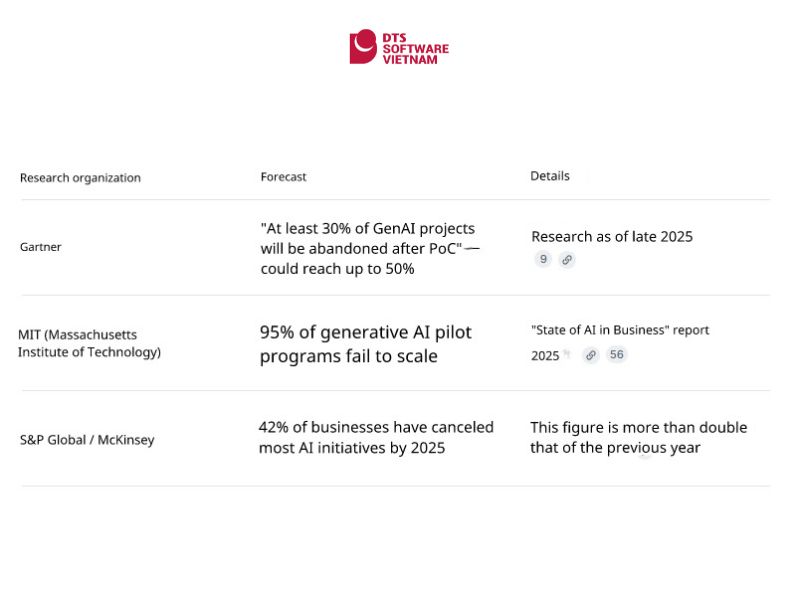
95% of organizations have yet to see any return from their large-scale investments in Generative AI, estimated at around $30 billion to $40 billion per year.
This gap between companies that are simply “using Generative AI” and those that are actually generating profit from it is creating a clear dividing line. Experts often refer to this as the “GenAI Divide.”
Learn more about the GenAI Divide here.
Where Generative AI Can Create Real Business Value
Improving Knowledge Work Productivity
One of the most immediate ways Generative AI can create value is by supporting repetitive tasks in knowledge-based work. It can summarize long documents, draft emails, turn meeting notes into structured minutes, classify feedback, suggest report content, and help employees retrieve information from internal knowledge bases more efficiently.
For businesses that handle large volumes of documents and information, Generative AI can significantly reduce the time spent processing and searching for information. However, to make this technology truly effective, companies need well-organized data, clearly defined access permissions, and a reliable process for reviewing AI-generated outputs.
When applied in the right model, Generative AI should act as a productivity accelerator — a digital assistant that helps people work faster and smarter. Human teams still play the essential role of reviewing, making decisions, and taking final responsibility.
Enhancing Software Development Quality
In the IT industry, Generative AI is having a significant impact across the software development lifecycle. It can assist engineers with writing code, suggesting refactoring options, generating unit tests, analyzing bugs, creating technical documentation, summarizing requirements, and supporting testing activities.
The key point is that Generative AI is not here to replace software engineers. Instead, it helps reduce repetitive tasks so engineers can focus more on system architecture, business logic, security, performance, and user experience — the areas where human expertise and judgment matter most.
For a technology service provider like DTSVN, Generative AI can become a powerful enabler for improving delivery quality, accelerating project response times, and creating a smoother, more effective collaboration experience for customers.
Upgrading IT Outsourcing Services
In the IT outsourcing model, customers are no longer looking only for technical resources. They are increasingly seeking partners who can provide consulting capabilities, optimize processes, and create additional business value.
Generative AI can help technology service providers move beyond the traditional model of simply “supplying execution resources” and evolve into partners that work alongside customers to solve real business challenges.
For example, Generative AI can support requirement analysis, create specification documents, review quality checklists, standardize project knowledge, assist with bilingual communication, and automate parts of the reporting process.
For Japanese customers, where quality, security, consistency, and process discipline are especially important, the use of Generative AI must go hand in hand with risk management, data governance, and a human-in-the-loop approach.
Creating New Value in BPO and Data Processing
Generative AI also holds strong potential for BPO services, especially in operations that involve documents, data, and business processes. It can support tasks such as extracting information from documents, summarizing records, classifying content, standardizing data, preparing initial translations, generating reports, and helping teams search internal process information more efficiently.
However, for tasks that require a high level of accuracy, Generative AI should be combined with validation systems, business rules, and human approval workflows. The right approach is not to let Generative AI fully automate everything on its own, but to design a hybrid process where AI and people work together.
By combining the speed of AI with human judgment and quality control, businesses can improve both operational efficiency and output quality.
Key Challenges Businesses Face When Implementing Generative AI
Lack of Clear Value Direction and Goals
Many businesses start with small, isolated Generative AI experiments, but lack a clear roadmap for connecting these efforts to their broader business strategy. As a result, resources become fragmented, teams may duplicate similar initiatives, and high-impact solutions often struggle to scale beyond the pilot stage.
Talent Gaps and Limited Cross-Functional Collaboration
Successful Generative AI adoption requires companies to rethink workflows and redefine responsibilities across teams. However, the knowledge gap between business and technical teams often slows this process down.
Critical roles such as data engineers, AI operations specialists, and model governance experts remain in short supply, making it difficult for many organizations to build experienced teams that can support Generative AI at scale.
Lack of Momentum and Execution Mechanisms
Even when senior leadership shows strong interest in Generative AI, many organizations still lack clear ownership and structured processes to execute their AI strategy.
At the operational level, teams may not fully understand how to use Generative AI tools effectively, or they may lack the motivation and support needed to adopt them in daily work. Without clear ownership, practical guidance, and internal enablement, Generative AI initiatives can easily lose momentum.
Fragmented Data and Technology Foundations
Many companies still lack a clear data strategy. Some attempt to build overly complex centralized platforms, while others run Generative AI pilots independently across different departments.
These pilot projects often rely on different tools, infrastructures, and data sources, making it difficult to reuse capabilities, standardize processes, and scale successful use cases across the organization. To create long-term value, businesses need a more connected data and technology foundation that supports consistency, governance, and scalability.
How to Implement Generative AI to Create Real Business Value
Start with Business Challenges, Not AI Tools
A common mistake many companies make is starting with the question, “Which AI tool should we use?” A better question is: “Which processes are consuming too much time, cost, or human effort — and where can Generative AI make a meaningful improvement?”
By starting with a clear business challenge, companies can more easily define the right use cases, KPIs, required data, and implementation scope. Generative AI should be prioritized for use cases that happen frequently, rely on reasonably clear data, can be standardized, and have measurable impact.
For example, businesses can begin with specific goals such as reducing the time needed to create reports, shortening the time spent searching for internal documents, accelerating customer request handling, helping engineers generate test cases, or improving response speed within project teams.
Build the Right Data Foundation
Generative AI becomes truly valuable only when it is connected to the right data. If data is scattered, outdated, poorly governed, or not standardized, AI-generated outputs can become inaccurate, inconsistent, or difficult to control.
That is why businesses need to build a solid data foundation, establish internal knowledge bases, and put data governance mechanisms in place before scaling Generative AI across the organization.
One notable approach is RAG, or Retrieval-Augmented Generation. RAG allows Generative AI to retrieve relevant information from internal data sources before generating a response. This helps make AI outputs more grounded, contextual, and aligned with the company’s actual knowledge.
For businesses, RAG can be applied to internal chatbots, technical document search assistants, customer support systems, and project knowledge search tools. With the right data foundation, Generative AI can move beyond a general-purpose tool and become a practical solution that supports real business operations.
Establish Governance, Security, and Risk Control
Generative AI can create significant business value, but it also comes with risks. These may include data leakage, inaccurate responses, unverified content, potential copyright issues, or bias caused by the input data.
That is why businesses need to establish clear AI usage policies, define what types of data can be entered into AI systems, set up approval workflows for AI-generated outputs, and implement ongoing monitoring mechanisms. This is especially important for technology companies that provide services to customers in areas where security, reliability, and trust are critical.
Gartner has identified AI Security Platforms as one of the strategic technology trends for 2026. The firm also predicts that by 2028, more than 50% of enterprises will use AI security platforms to protect their AI investments. In addition, Gartner expects that more than half of the GenAI models used by enterprises by 2028 will be domain-specific or business-function-specific models.
These trends show that enterprise Generative AI will not be limited to general-purpose large language models. The future of Generative AI will be closely tied to specialized models, proprietary data, stronger security controls, and deeper integration into business operations.
DTS Software Vietnam’s Direction for the Future
As part of its development direction for the coming period, the General Director of DTS Software Vietnam emphasized:
“DTSVN will actively promote the adoption of advanced technologies, especially Generative AI, to deliver higher value-added services to customers.”
This direction shows that DTSVN does not view Generative AI simply as a new technology trend. Instead, it is seen as an important part of the company’s strategy to enhance service capabilities, optimize processes, and create more practical value for customers.
As a technology company serving enterprise customers, DTSVN can approach Generative AI through three key layers of value: applying it internally, improving the quality of existing services, and developing new high value-added services for customers.
Applying Generative AI Internally
Generative AI is being applied within DTSVN to improve work productivity, support training, strengthen knowledge management, analyze documents, enhance internal communication, and standardize operational processes.
This is an important step in helping DTSVN’s teams better understand how Generative AI can be used in a real enterprise environment. Once employees are able to use Generative AI effectively, responsibly, and in alignment with existing workflows, the company will have a stronger foundation for expanding this technology into specialized operations and customer-facing services.
At this stage, Generative AI can serve as a “digital assistant” that supports employees in handling repetitive tasks, reducing the time spent searching for information, drafting documents, summarizing content, and making faster, more informed decisions.
Improving the Quality of Existing Services
Building on its internal use of Generative AI, DTSVN is gradually incorporating this technology into its existing services, including software development, testing, system maintenance, data processing, and project operation support.
In software development, Generative AI can assist engineers with writing source code, creating unit tests, analyzing bugs, summarizing requirements, reviewing technical documentation, and standardizing testing processes. In document and data processing services, it can support information classification, record summarization, report generation, and faster execution of operational workflows.
What matters most is that DTSVN does not approach Generative AI as a replacement for people. Instead, it is used to strengthen the capabilities of technical and operations teams. When combined with professional expertise, quality control processes, and human oversight, Generative AI can help improve productivity, consistency, and output quality throughout the service delivery process.
Developing High Value-Added Services for Customers
Looking further ahead, the adoption of Generative AI opens new opportunities for DTSVN to develop higher value-added services for enterprise customers.
Rather than simply providing technical resources or delivering services based on predefined requirements, DTSVN can work alongside customers to identify business challenges, advise on practical use cases, design and build suitable solutions, and integrate Generative AI into their existing systems.
This approach is closely aligned with DTSVN’s direction of using advanced technologies to create real business value. Generative AI does more than help businesses work faster. It can also help customers optimize processes, make better use of data, and strengthen their competitiveness in the digital business environment.
Taking a Safe and Responsible Approach to Generative AI
As DTSVN continues to promote the use of Generative AI, safety, security, and risk management must remain at the center of its approach.
In an enterprise environment, especially when working with customer data, Generative AI needs to be implemented under clear principles. These include proper data access controls, review and approval of AI-generated outputs, information security safeguards, and a clear definition of human responsibility throughout the usage process.
This approach allows DTSVN not only to keep pace with emerging technology trends, but also to build customer trust through professionalism, caution, and responsibility.
It also provides an important foundation for Generative AI to become a long-term capability for DTSVN, rather than just a short-term experimental tool.
With a clear direction to promote the adoption of advanced technologies, especially Generative AI, DTSVN has the opportunity to elevate its role from a technology service provider to a trusted partner that works alongside customers on their journey of innovation, operational optimization, and sustainable value creation.